
Weight guide
AllChinaBuy Volumetric Weight: Formula and Examples
Calculate the volume weight shown by AllChinaBuy’s public shipping tool, compare it with scale weight and find the packing change that matters.
Verified on the public interface
Three facts to carry forward
- The public formula is length × width × height ÷ 5,000 when dimensions are centimetres.
- The calculator explains that the larger of actual and volume weight can control route pricing.
- Final rounding and line rules should be checked on the live quotation.
Section 01
Use exterior packed dimensions, not product dimensions
Measure the final parcel’s longest length, width and height at the outermost points. The calculator labels these as the box size after packing. A shoe may be 30 cm long, but its retail box, protective wrap and consolidated carton can produce a much larger shipping cube. Using product dimensions gives a neat answer to the wrong question.
For a pre-purchase estimate, add realistic clearance for the retail or protective box and any consolidation. Use a high case if the seller dimensions are missing. After warehouse packing, replace the estimate with measured exterior dimensions and rerun the official calculator before paying.
Section 02
Apply the public calculator formula
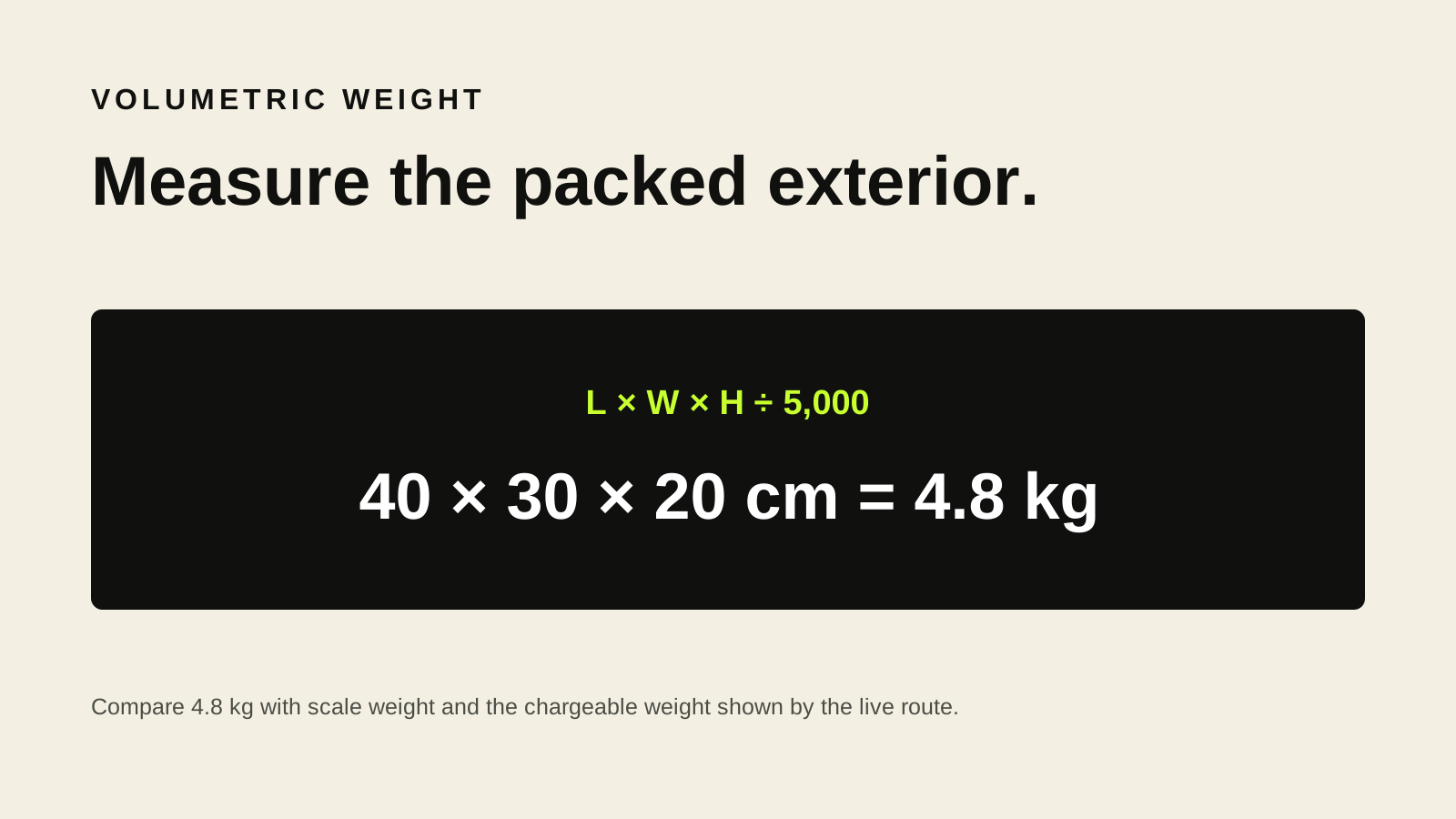
AllChinaBuy’s public page displays Length × Width × Height × 1,000 ÷ 5,000. With centimetres and kilograms, this simplifies to L × W × H ÷ 5,000. For a 40 × 30 × 20 cm parcel, the calculation is 24,000 ÷ 5,000 = 4.8 kg. Write down the dimensions and result so a later packing change can be compared.
A 30 × 20 × 10 cm parcel produces 1.2 kg. If its scale weight is 2.0 kg, it is mass-heavy relative to this formula. If the 40 × 30 × 20 cm parcel weighs 2.6 kg, it is space-heavy. The distinction tells you whether to focus on removing mass or reducing the box.
- 40 × 30 × 20 cm = 4.8 kg volume weight
- 30 × 20 × 10 cm = 1.2 kg volume weight
- Record scale, volume and displayed chargeable weight separately
Section 03
Compare with actual weight
The calculator text explains that logistics providers can calculate using the larger of actual and volume weight. For the 4.8 kg volume example, a 2.6 kg scale weight may still be charged as 4.8 kg on such a line. If the same box weighs 6.1 kg, actual weight is larger and reducing empty space alone may not change the chargeable figure.
Use the route’s displayed calculation rather than assuming every line behaves identically. Lines can apply rounding, minimum units or different operational rules. The formula explains the pressure created by volume; the live quotation shows how the selected line prices the actual parcel.
Optimize the larger driver: dimensions for a space-heavy parcel, mass for a mass-heavy parcel.
Section 04
Test packing changes with sensitivity analysis
Change one dimension at a time. Reducing the 40 × 30 × 20 cm example to 40 × 30 × 16 cm lowers volume weight to 3.84 kg. Reducing only one centimetre of length lowers it to 4.68 kg. This shows why removing a tall empty layer can matter more than trimming a small edge.
Compare keeping and removing seller courier boxes, folding nonessential cartons and separating bulky low-value packaging. Never optimize below safe protection. A crushed product is not a shipping saving. Ask what reinforcement replaces removed packaging and use the smallest safe outer carton, not the smallest imaginable carton.
Section 05
Keep warehouses and category rules in the calculation
A perfect volume estimate is useless for a line the item cannot use. Enter destination, truthful category and actual warehouse before comparing cost. The public calculator says the warehouse’s classification prevails and that items in different warehouses cannot be shipped together. Build only scenarios that satisfy those constraints.
For a mixed parcel, the most restricted item may determine route choice. Calculate the consolidated parcel and plausible split parcels. Sometimes separating a sensitive or bulky item creates more route choice for the remainder even though there are two shipments.
Section 06
Do not turn the divisor into a universal promise
This guide reports the formula visible on AllChinaBuy’s public English calculator on July 17, 2026. Carrier rules, rounding and route availability can change. Always use the live calculator and final parcel quotation. If a route card shows a different chargeable result, ask for the line-specific rule rather than forcing the general example onto it.
The useful habit is transparent arithmetic. Save the dimensions, scale weight, formula result, route and date. When a quote changes, those inputs make it possible to identify whether the cause was packing, classification, route pricing or a different calculation rule.
Primary evidence
Official pages checked
These links go to AllChinaBuy’s public mobile website. Dynamic content, logged-in prices and availability can change after our review date.
- AllChinaBuy Shipping Calculator ↗Public calculator fields, chargeable-weight guidance, route notes and warehouse restrictions.
- AllChinaBuy Order Confirmation ↗Public order-stage descriptions for inspection, detailed photos, original packing and cost timing.