
Shipping guide
AllChinaBuy Shipping Cost 2026: Weight, Routes & Calculator
A fact-based budgeting method using the fields and warnings in AllChinaBuy’s public shipping calculator.
Verified on the public interface
Three facts to carry forward
- The calculator asks for destination, category, warehouse, packed dimensions and weight.
- Its public formula converts centimetre dimensions to volume weight with L × W × H ÷ 5,000.
- Items in different warehouses cannot be combined into the same shipment.
Section 01
Build a delivered-cost ledger before buying
Start with separate columns for product price, seller-to-warehouse delivery, optional warehouse services, packing materials, international freight, payment conversion and destination charges. The public order page makes the timing clear: international delivery is calculated after goods reach the warehouse. A single “total” copied during the product checkout therefore leaves out the largest unknown for many orders.
Use a low, expected and high estimate instead of one precise-looking number. The low case uses the seller’s product weight and compact dimensions, the expected case adds realistic packaging, and the high case adds bulky packing or a more expensive eligible route. If the high case breaks the budget, the order is not yet safe merely because the low case looks attractive.
Section 02
Enter the calculator fields in the right order
AllChinaBuy’s public calculator asks for destination country, product category, sending warehouse, item weight and the size of the box after packing. Begin with destination and category because they influence eligibility. Then select the warehouse that will actually hold the item. Finally enter a realistic packed weight and three exterior dimensions; product-only dimensions will understate a shoe box, structured bag or protected fragile item.
The category selector is explicitly described as a reference, with final classification determined at the warehouse. If a product contains a battery, liquid, magnet, powder, food or another sensitive feature, use the closest truthful category and read every line restriction. Do not select a harmless category simply to make a cheaper route appear. A route that cannot accept the warehouse classification is not a usable budget option.
- Destination country
- Truthful product category
- Actual receiving warehouse
- Packed weight and exterior dimensions
Section 03
Compare actual and volumetric weight
The public calculator shows the formula Length × Width × Height × 1,000 ÷ 5,000, which is equivalent to dividing cubic centimetres by 5,000 to get kilograms. A 40 × 30 × 20 cm parcel produces 4.8 kg of volume weight. If it weighs 2.6 kg on a scale and a route charges the larger figure, the line prices it as 4.8 kg. Compacting empty space can matter more than removing a small amount of mass.
Do not assume every line uses identical rounding or divisors. Use the formula as the calculator’s planning reference, then read the current line details and final warehouse quotation. Record all three figures—actual weight, volume weight and the chargeable weight shown—so you can see whether the parcel is mass-heavy or space-heavy and choose packing changes intelligently.
For a space-heavy parcel, reducing box dimensions can save more than removing a few grams.
Section 04
Respect the warehouse boundary
The public calculator warns that products stored in different warehouses cannot be shipped together. It also displays a specific notice that the Hong Kong warehouse only receives packages sent from outside mainland China, including Hong Kong, Macao and Taiwan contexts. These are operational boundaries, not labels that can be ignored when planning consolidation.
Create a warehouse column in the item ledger and group only eligible items in the same location. If a product is assigned elsewhere, calculate it as a separate parcel unless the current account provides an explicit transfer option and price. Two smaller parcels can cost more than one consolidated parcel, so warehouse assignment deserves attention before purchase, not after every item arrives.
Section 05
Read route cards beyond the headline price
The public calculator exposes route details such as first-weight charge, added-weight charge, fuel-related fees, operating fees, estimated timing, delivery method and tax-related labels. A low first number may not remain cheapest at your parcel’s chargeable weight. Compare the complete estimate for the same inputs and read the restrictions attached to each line.
Delivery windows are reference estimates supplied by logistics providers, according to the calculator text. Freight can also fluctuate with market conditions. Do not convert “estimated days” into a promised arrival date, and do not spend the entire budget on the initial quote. Save a dated screenshot or note of the route result, then rerun it when the warehouse measurements are final.
Section 06
Use buffers based on the real uncertainty
A flat percentage buffer is better than none, but a targeted buffer is more useful. Add dimension risk for shoes, bags and protective packing; classification risk for sensitive goods; exchange-rate risk for payment; and destination risk for taxes or handling. If several items are unmeasured, keep the buffer wider. Once warehouse data replaces estimates, narrow it.
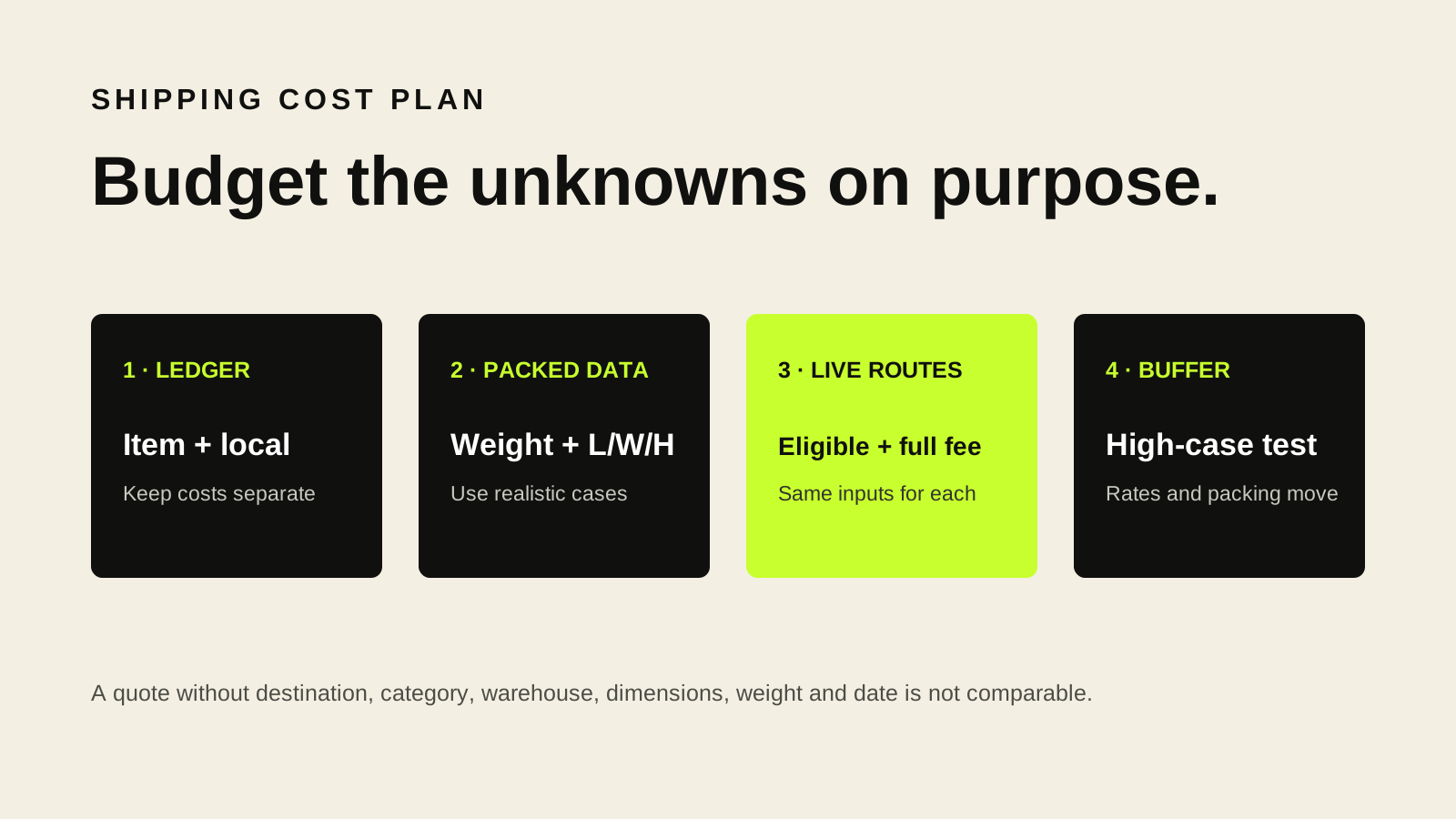
This guide does not publish a universal price per kilogram because AllChinaBuy’s own public calculator says rates can change and route eligibility depends on live inputs. Use the official tool on the day you plan and again before submission. Any article that gives a timeless route price without destination, category, warehouse, dimensions and date is missing the facts needed to make that number meaningful.
Primary evidence
Official pages checked
These links go to AllChinaBuy’s public mobile website. Dynamic content, logged-in prices and availability can change after our review date.
- AllChinaBuy Shipping Calculator ↗Public calculator fields, chargeable-weight guidance, route notes and warehouse restrictions.
- AllChinaBuy Order Confirmation ↗Public order-stage descriptions for inspection, detailed photos, original packing and cost timing.