
Shoe sizing
AllChinaBuy Shoe Sizing: Insole Measurements and QC Photos
Compare seller size charts with a well-fitting pair, write precise insole measurement requests, and check shoe QC photos without confusing labels with fit.
Key points
Before you begin
- A size label needs context: chart system, measurement method and the exact model or option.
- Foot length, removable insole length and exterior outsole length are different measurements.
- QC photos can reveal visible mismatches but cannot guarantee comfort, authenticity or long-term durability.
Section 01
Begin with the exact shoe and the exact size system
An AllChinaBuy shoe sizing decision begins with the original listing and selected option, not a universal conversion chart. Two sellers can use the same number while describing different size systems or measurement methods. Record the model, seller, colour, selected size and the chart shown for that listing. If a chart appears to cover several models, ask whether it applies to the exact item. A familiar brand name or similar photograph does not establish that the fit matches a pair you already own.
Treat UK, US and EU labels as labels until the source explains the corresponding measurements. Do not silently apply a men's chart to a women's model, or an adult chart to a children's product. If the listing contains conflicting tables, save both and seek clarification. The purpose of this guide is to compare evidence consistently. It cannot supply a guaranteed AllChinaBuy size chart because the underlying products, sellers and individual fit preferences are not identical.
Section 02
Use a well-fitting reference pair
Choose a pair you actually wear comfortably for a similar activity and sock thickness. Record its stated size and model, but also write down what makes it fit: toe space, heel hold, width and any pressure point. A shoe that is long enough can still be too narrow or too shallow. A loose heel can be a problem even when a length measurement looks reasonable. A reference pair gives the numbers a practical context that a generic conversion table lacks.
If the reference pair has a removable insole that can be taken out without damage, measure it using a documented method. Lay it naturally on a flat surface and show the start and end of the ruler. Do not stretch a flexible insole or force a curved part flat without noting what you did. Keep a photograph of the method so a requested warehouse measurement can use comparable endpoints. If the insole is fixed, do not tear it out merely to obtain a number.
Section 03
Keep foot, insole and outsole measurements separate
Foot length describes the foot under a specified measurement method. Insole length describes the removable component, while outsole length describes an external part of the shoe. These values can differ for perfectly ordinary construction reasons. A thick heel, extended toe bumper, curved insole or raised heel cup changes what is being measured. Comparing a warehouse outsole measurement with your reference insole can therefore create an apparent sizing error that is really a method mismatch.
Use centimetres or millimetres consistently and retain the unit with every value. If someone supplies a number without naming the measured component, request clarification before converting it into a size. A ruler that starts away from zero also needs to be read as a difference between two marks. Ask for the full measurement to be visible, including the starting point, endpoint and scale. The camera should make those marks readable without relying on a caption typed by someone else.
- Name the measured component.
- Use the same endpoints on the reference and ordered pair.
- Keep the unit beside the number.
- Show the complete ruler scale and both endpoints.
Section 04
Write a measurement request that answers one decision
A request such as ‘check the size’ leaves too much room for interpretation. A more useful request identifies the item and asks for a single observable result: if the insole is removable without damage, photograph its heel-to-toe length in centimetres with the ruler and both endpoints visible. If removal is not possible, ask the service to explain what alternative measurement it can provide. Do not request destructive handling without understanding and accepting its consequences.
The historical AllChinaBuy public order description reviewed for this site's July guide recommended one precise requirement per detailed-photo request. That historical description is not confirmation of current availability or fees. The October maintenance notice makes it especially important to verify that a request can currently be accepted. When a new photograph arrives, compare it against your wording. If it shows the wrong component or hides the ruler's beginning, explain the mismatch instead of treating an unusable measurement as reliable evidence.
Section 05
Review the pair before inspecting tiny details
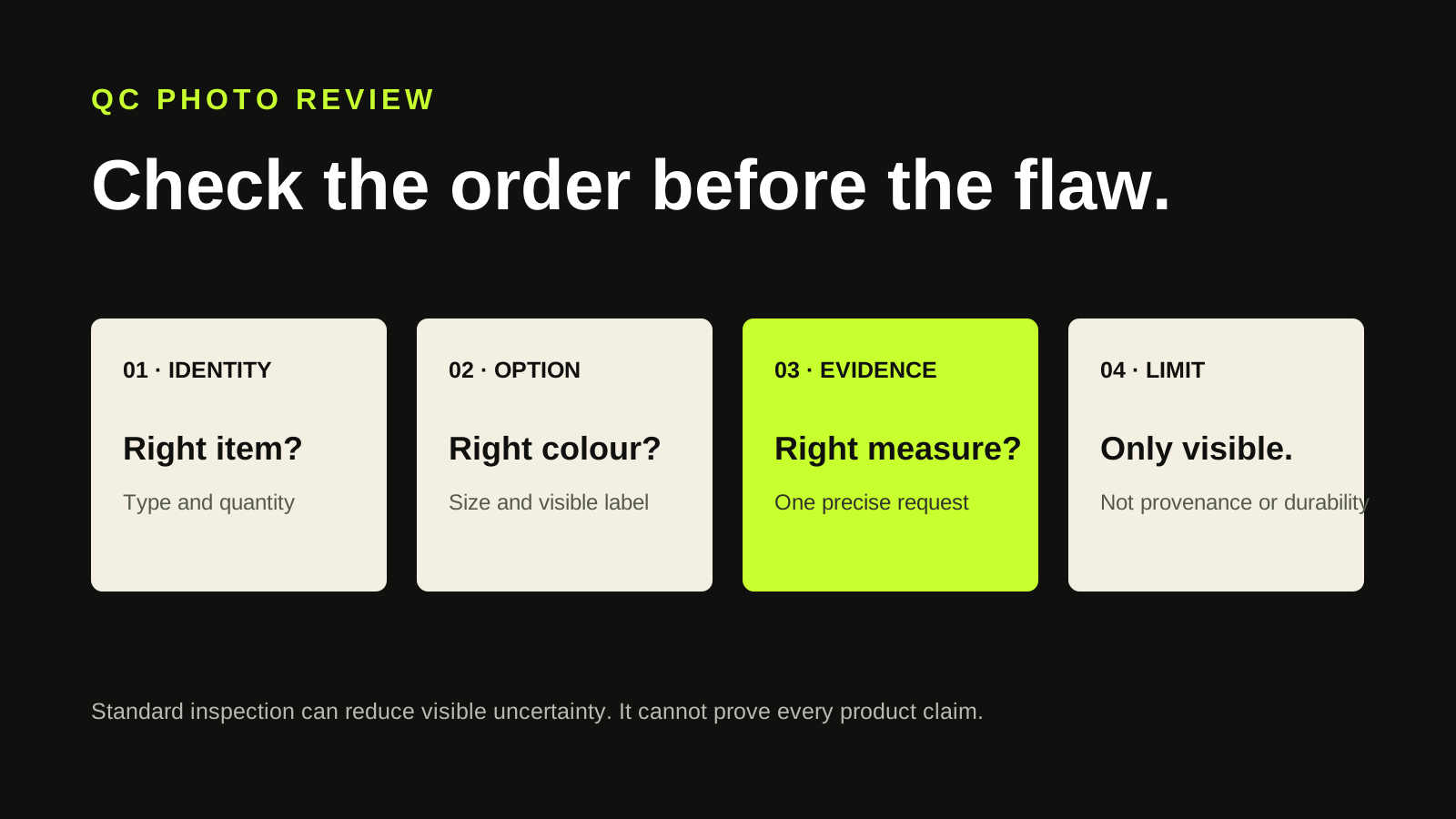
Start the AllChinaBuy shoe QC review with product identity, colour, quantity and the labels on both shoes. Confirm that the photographed pair corresponds to the selected option. Ask whether an image belongs to your received goods when its connection to the order is unclear. Seller listing photographs and editorial illustrations are useful references, but they should not be presented as your warehouse evidence. Keep those image types labelled in the record.
Then compare left and right shape, visible seams, closure parts, outsole edges and obvious damage. View a suspected asymmetry from a centred angle before calling it a defect. Perspective, uneven placement and lighting can affect what a photograph suggests. Describe the observable feature and request a clarifying angle when necessary. A photo review cannot authenticate a branded item, prove material composition or predict months of wear. Avoid making those claims from logos, packaging or a single favourable image.
Section 06
Turn the comparison into an explicit decision
Use a small worksheet containing the selected label, seller chart method, reference measurement, warehouse measurement and unresolved fit concern. For a hypothetical example, a reference insole measured at 27.0 centimetres and an ordered insole measured at 27.6 centimetres differ by 0.6 centimetres. That arithmetic does not prove the second shoe is wrong or right. First confirm the same endpoints and shape, then consider width, construction and the wearer's actual preference. This example is not a size recommendation.
Choose one recorded outcome: enough evidence to proceed, another measurement needed, or a return enquiry required. If a return may be necessary, check the actual seller and order terms before authorising international shipping. Do not assume removing packaging or consolidating a parcel leaves every remedy unchanged. Link the sizing record to the order reference so a later response can identify the correct item. Keeping the decision written also helps you avoid repeating the same uncertain purchase in another colour.
Section 07
Resolve an unclear measurement before interpreting the size
Imagine a warehouse photograph shows a shoe beside a tape, with the beginning of the tape hidden under the heel. The visible endpoint reads 28 centimetres. That image does not necessarily establish a 28-centimetre length because the starting mark is unknown. It also appears to measure the exterior outsole, while your reference note contains an insole length. There are two separate evidence problems: an unreadable starting point and a different measured component. Converting the endpoint into a size would leave both problems unresolved, even if the resulting number happens to match a familiar chart.
A better follow-up identifies both issues in plain language and asks whether a comparable measurement can be provided without damaging the shoe. Keep the first photograph, your clarification and the replacement photograph together. If a removable insole cannot be shown, record that limitation and decide whether the remaining evidence is sufficient. You might ask for the seller's model-specific chart or a clearer option label, but neither should be presented as the missing physical measurement. This hypothetical case illustrates how a precise request can prevent a false conclusion. It does not mean every insole is removable or every measurement service is currently available.
Section 08
Keep the useful measurements for future purchases
After receiving and trying the shoes, add your own fit observations to the record. Note the sock type and whether the pair was tried indoors, then describe any difference between the photograph-based expectation and actual wear. Record only your real experience. Do not invent customer testimonials or generalise one person's fit to every size and foot shape. If you share the comparison, distinguish measured values, personal impressions and unresolved construction details.
Use that history to improve the next request. A previous length measurement may have been sufficient, or it may show that you also needed usable width or a clearer view of the heel shape. Compare like with like and preserve the exact model reference. During any period when AllChinaBuy account functions cannot be verified, you can still organise saved charts and existing photographs, but new service availability must be checked separately. Better sizing decisions come from consistent measurements and honest limits, rather than confidence in a generic conversion number.
Primary evidence
Sources and evidence limits
Source names and their scope are recorded below. The review date matters: historical service descriptions do not establish current availability, account terms or the outcome of an individual order.
- AllChinaBuy public homepage — maintenance noticeChecked again on November 3, 2026. The notice describes maintenance following a hacker attack and directs order enquiries to support. It gives no confirmed reopening date or order-specific outcome.
- AllChinaBuy public order-confirmation description — historical referenceDetailed-photo wording recorded in this site's July 17, 2026 review. Not reverified as a currently available service during the October maintenance period.